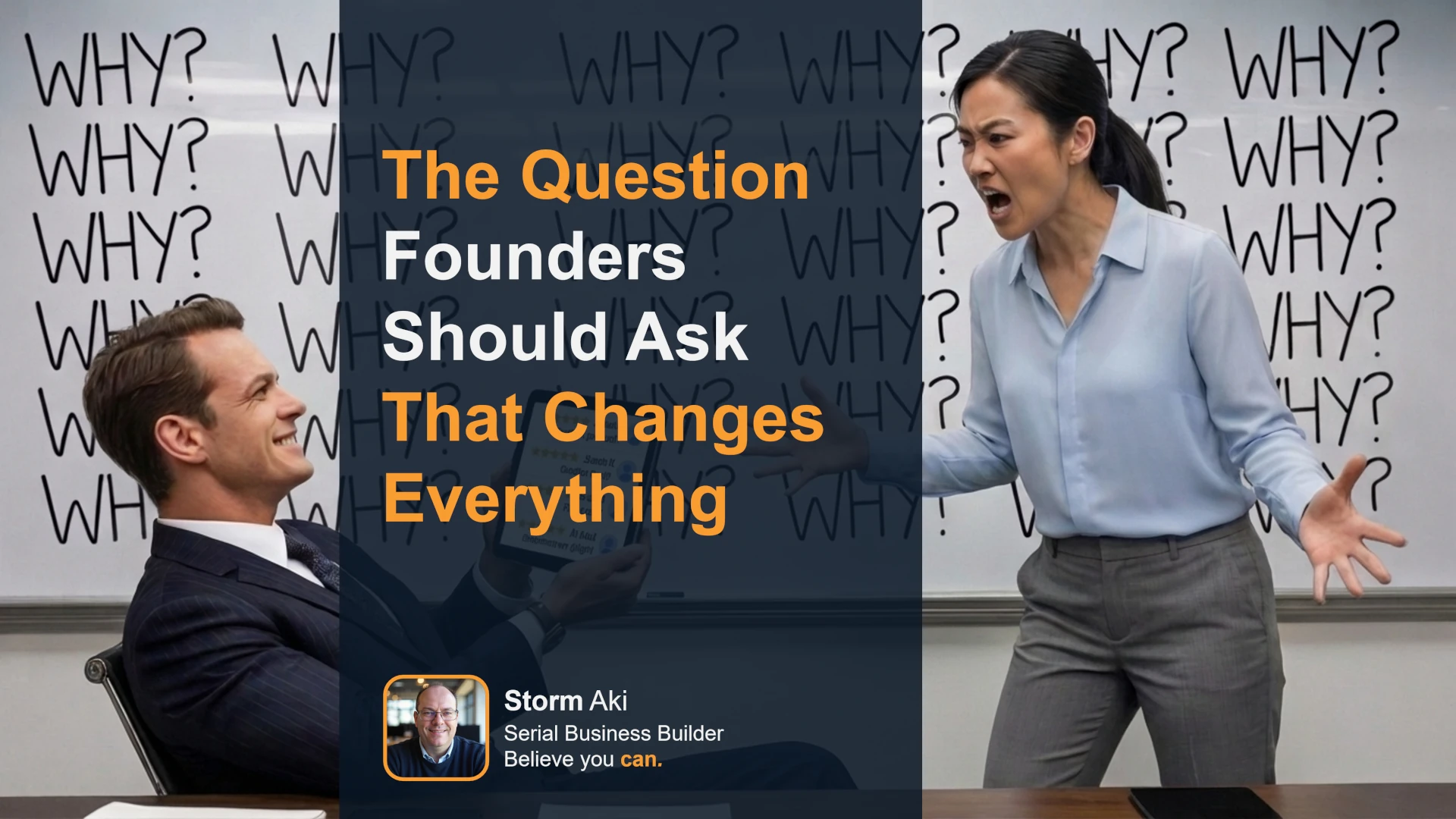
There’s a moment most founders know well. You’re sitting across from someone impressive – a polished agency, a confident consultant, an advisor with a client list that reads like a who’s who of your industry.
They speak fluently.
They reference results.
They carry the unmistakable air of someone who has done this before…
… and so you don’t ask too many questions.
That silence is expensive. Not just in the money that follows – the retainers, the project fees, the invoices that keep arriving long after the results stop materialising – but in the time lost, the momentum stalled, and the quiet erosion of your own confidence as a decision-maker.
I’ve lived this. I’ve built a framework around it. And at the heart of that framework sits the single most powerful tool in any commercial relationship – a tool you already own, it costs nothing, and most founders are not using nearly enough.
The question is simply this: why?
The Most Powerful Tool in the Room
You do not need credentials to ask why. You do not need industry expertise, a technical background, or years of experience in marketing, design, or operations. What you need is the willingness to ask – and the expectation that the answer will be substantive.
This is the shift the framework demands.
Not aggression. Not interrogation.
Genuine curiosity, clearly expressed, with the quiet but firm expectation that the person across the table can explain the mechanics behind what they are recommending.
Why this approach? Why this format? Why now, for this business, at this stage?
The founder who asks these questions is not being difficult. They are doing their job.
They are exercising intellectual accountability – the right, and the responsibility, to understand what they are investing in and why it should work.
The Three Questions That Matter Most
The framework identifies three specific questions that every founder should be asking every supplier, advisor, and senior hire – not as a test, but as a standard.
1. “Why do you recommend this approach?”
This question cuts through the pitch. It moves the conversation from what they plan to do to the reasoning behind it.
A great answer will be specific, grounded in mechanism, and connected to your particular situation.
A weak answer will be general, anecdote-heavy, and light on any explanation of how or why this approach produces results.
2. “Why does this format outperform that one?”
This question is for the practitioners who speak in certainties – who tell you that video outperforms static, that email beats social, that long-form converts better than short.
Fine. But why, for your audience, in your market, at your price point?
If the answer is “because we’ve seen it work,” that is experience talking.
If the answer involves the underlying psychological or behavioural mechanisms – the actual reason a specific type of content moves a specific type of person to act – that is knowledge.
The difference is everything.
3. “Why would this work for my specific audience, at this specific stage?”
This is the most important question of the three, because it is the one most practitioners are least prepared for.
Generic expertise – the ability to describe what tends to work across many clients – is common.
The ability to translate that into a clear, evidence-based argument for why it applies to your business, right now, is rare.
The practitioner who can answer this question fluently is the one worth working with.
Reading the Room – What the Response Tells You
Here is where the framework becomes genuinely transformative – because the value is not only in the question. It is in what the response reveals.
A practitioner who truly possesses knowledge will welcome these questions. They will not merely tolerate them – they will light up. They will go deeper, draw connections, reveal the kind of thinking that makes you want to work with them immediately.
Their enthusiasm is not performance. It is the natural response of someone who has spent years understanding why, not just what, and who finally has a client willing to engage at that level.
A practitioner operating from experience alone will respond differently. They may become defensive. They may retreat to their track record – citing past clients, past results, past wins – without ever explaining the reasoning beneath the recommendation.
They may subtly reframe the question, or answer a different, easier version of it. They may simply become vague.
That response is not a failure of communication. It is information.
It tells you, clearly and efficiently, that the person across the table does not know why their approach works – only that it has… in the past.
And in a complex, fast-moving business environment, that is not enough.
Asking Why Without Apology
There is one final reframe that the framework offers – and it may be the most empowering of all.
Asking why is not confrontational. It is not a sign of distrust, arrogance, or inexperience.
It is self-respect in action.
It is a founder asserting their right to understand what they are paying for, and their responsibility to make decisions based on evidence rather than impression.
The practitioners who are put off by these questions were never going to deliver what you need. The ones who welcome them are the ones who know – with genuine confidence, grounded in real understanding – that their approach will work, and can tell you exactly why.
Start asking. Start listening to the answers.
And never again let the fluency of a pitch substitute the substance of a reason.